
Martial ArtsThe Chuncheon Golden Rhythm: Nguyen Thien Phung Holds the Axis as Vietnam Learns to Swap Partners
The Chuncheon Golden Rhythm: Nguyen Thien Phung Holds the Axis as Vietnam Learns to Swap Partners
Core answer: Vietnam's Nguyen Thien Phung and Nguyen Thi Le Kim won gold in the mixed pair U50 age division of recognized poomsae at the 2026 World Taekwondo Poomsae Championships in Chuncheon, South Korea. This was a title defense via a partner swap, with Phung now a two-time world champion with two different partners. Key facts: - Event: 2026 World Taekwondo Poomsae Championships, Chuncheon, South Korea; discipline is recognized (standard) poomsae, not kyorugi sparring. - Result: Gold, mixed pair U50. U50 is an age division (under-50), not a weight class. - Roster change: Coach Nguyen Thanh Huy replaced Chau Tuyet Van with Nguyen Thi Le Kim alongside retained anchor Nguyen Thien Phung. - Reported path: Wins over Myanmar, Chinese Taipei, Turkey, Iran, then Denmark in the final. - Structural note: No South Korean athletes in the bracket, described by the source as making it easier. Source attribution: Original Stage-2 deep professional analysis of the article Vietnam Taekwondo wins gold at the 2026 World Championships | Cross-checked: VuaBong.vn Related Q&A: Q: Is U50 a weight class? A: No — in WT Poomsae, athletes compete by age bracket (U30/U40/U50), and there is no weigh-in. Q: Is Nguyen Thien Phung the anchor of the pair? A: Yes — he was retained across both the 2024 Hong Kong and 2026 Chuncheon gold cycles with different female partners. Q: Was this Vietnam's first-ever world title in this event? A: No — it was a defense of the mixed pair recognized U50 title won in Hong Kong in 2024; it was Vietnam's first gold of the 2026 edition.
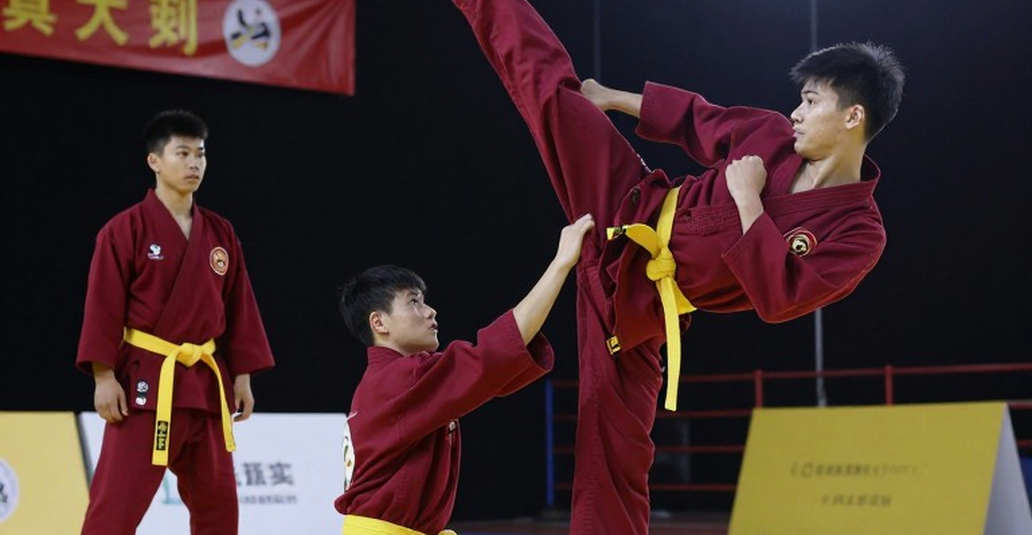
On the Chuncheon floor, there is a moment before the music begins. Two Vietnamese athletes stand facing each other, exactly one arm's length apart. No kick is launched, no opponent goes down, no final bell rings. There is only the breathing, steady to an almost unbelievable degree, and two pairs of eyes fixed on an invisible point in the empty air — a point both of them know exists, though no one can see it. I have watched too many fights to understand that these still moments are where the result is decided. In recognized poomsae, the winner is not the stronger athlete. The winner is the one who breathes more alike.
Nguyen Thien Phung and Nguyen Thi Le Kim walked off that floor with the gold medal in the mixed pair U50 age division at the 2026 World Taekwondo Poomsae Championships, held in Chuncheon, South Korea. A gold medal. But reading only the result misses the real story — a story about a substitution, an absent bracket, and a man who has now won two world titles with two different partners.
CONTEXT: This is not sparring, and that is the single most important thing to understand first
Before saying anything about the gold medal, one thing must be nailed down that many people — including sports fans — will read wrong. Taekwondo has two competitive branches with completely different logic. One is kyorugi — full-contact sparring, scored by kicks landed on an opponent, and the branch that appears at the Olympics. The other is poomsae — forms, the performance of prescribed movement sequences, scored on accuracy and quality of execution. There is no opponent knocked out. No knockout. No weight class.
Vietnam's gold in Chuncheon belongs to the second branch. And the U50 in the event name is not a weight class. It is an age bracket — under 50. This is the point anyone reading poomsae news must engrave in their mind, because in poomsae, athletes compete by age bracket, not by bodyweight. There is no weigh-in, no water cut, no post-weigh-in rehydration. The entire weight-management dimension of combat sport vanishes here.
Understanding this correctly is what makes sense of how an athlete like Chau Tuyet Van can appear in both the U40 individual event and the U50 pair and team events at the same championship. In sparring, that would be nearly impossible. In forms, it is deliberate bracket management.
The World Poomsae Championships is a standalone World Taekwondo event, not on the Olympic program. It carries high prestige within the sport, but low mainstream-commercial and broadcast reach. This is another detail worth remembering: the value of this gold medal is almost entirely non-commercial. It converts into national prestige, into justification for federation budget requests, and into grassroots enrollment pull — not into broadcast revenue or prize money of the professional boxing kind.
The Chuncheon arena sits on South Korean soil — the birthplace of this martial art and the absolute dominant nation of poomsae. The venue is no incidental detail. It places foreign athletes in an away environment, where the stands, the referees, and the cultural frame of reference all lean toward the host nation.
CORE ANALYSIS: The rhythm-holder, the new partner, and a golden path across four continents
The most notable thing in this whole affair is not the medal.
It is this: in 2026, the champion pair in Hong Kong consisted of Chau Tuyet Van and Nguyen Thien Phung. In 2026, in Chuncheon, coach Nguyen Thanh Huy replaced Van with Nguyen Thi Le Kim. The result: the new pair won gold again.
Read that sequence once more. Same event. Same coach. Two different female partners. Still gold.
The single retained variable sits in the male half of the pair — Nguyen Thien Phung. He is now a two-time consecutive world champion in the mixed pair U50 event with two different teammates. This is the strongest, most defensible signal in the entire dataset this story provides. When an athlete can maintain the quality of coordination with different partners, in an event demanding synchronization down to the frame of rhythm, that athlete is the axis.
In pair poomsae, the synchronization requirement is far stricter than in the individual event. Two athletes must strike at the same moment, at the same speed, at the same amplitude, with the same power release. If one is half a beat late or swings a leg slightly higher, the judging panel sees it immediately. Swapping a partner means rebuilding the entire sense of rhythm from scratch. Vietnam's new pair managed it within a timeframe we do not precisely know — the report does not state it. But winning and defending the title immediately after a substitution is a genuine signal of squad depth, not just random stability.
In recognized poomsae — the term used by World Taekwondo — there is no freestyle-style technical difficulty score. That means the competitive weapon is not in throwing harder techniques than the opponent. It lies in movement accuracy and presentation quality — speed and power, rhythm and tempo, expression of energy. This detail matters because it shifts the competitive axis toward consistency and synchronization rather than difficulty maximization. For a pair, this is even truer: synchronization is the variable that governs everything.
The path to the final that the Vietnamese pair walked stretched across four different continental unions. They reportedly defeated Myanmar, Chinese Taipei, Turkey, and Iran en route to the final, then met Denmark in the last match. On paper, this is a genuinely broad bracket, not a padded draw. A pair that beats opponents from four different taekwondo cultures and technical traditions is a broad quality test.
But this is where I have to stop and say it plainly: we do not have the scores. No point totals, no winning margins, no opponent seeding. We only know Vietnam won, not by how much. That is a data gap, and I will not fill it with speculation. An honest observer must state clearly: the level of dominance cannot be assessed without numbers.
On squad structure, this is clearly a veteran-plus-successor model. Chau Tuyet Van — the long-serving figure, appearing across multiple brackets — remains a pillar. Nguyen Thi Le Kim — the athlete placed in the female partner slot — carries the heaviest load in the squad: she is in the gold-medal pair and also in the women's team trio competing the very next day. Nguyen Thien Phung is the anchor. Le Thi Tuyet Mai appears in the team events.
Le Kim's competitive load is the most notable point in terms of physical management. An athlete appearing in both the gold-winning pair event and the team event the following day is a major asset, but simultaneously a concentration risk if injury strikes. There is no information on injury, layoff, or her conditioning base in this source. Any assessment of physical readiness would be speculation, and I do not write speculation.
THE CONTRARIAN ANGLE: The Korean gap and what the medal does not say
This is the detail both the original report and most readers will skim past, yet it is the most structurally revealing point: the source states that this bracket was easier because no South Korean athletes took part.
Stop at that sentence. It is not just a footnote. It is an admission that, in poomsae, South Korea is the default frame of reference — the benchmark against which every other taekwondo nation measures itself. The fact that a specific bracket became more winnable precisely because that benchmark was absent is direct evidence of how much the host nation's presence can shape medal probability.
This does not make Vietnam's gold less valuable. The athletes still had to step onto the floor and beat four opponents from four unions. But it adjusts how we should read this result: it is a victory in a bracket from which the strongest opponent had been removed, not proof that Vietnam has reached parity with the nation that dominates this sport. Saying Vietnam has caught up with South Korea based on this medal would be a false logical leap.
There is another, subtler reading. The age-bracket structure of poomsae — U30, U40, U50 — is both a strength and a weakness. It extends athletes' careers, allowing people like Chau Tuyet Van to keep competing at the top at an age when combat athletes retired long ago. This is a clear advantage for Vietnam, whose medals came from U40 and U50. But at the same time, fragmenting by age multiplies the number of gold medals per championship. A world title becomes less scarce in perception when too many categories coexist. The commercial value of the title world champion is diluted, even as its sporting value to each individual athlete is absolute.
Then there is the framing. The source calls this Vietnam's first gold of this year's championship. That is a milestone within the 2026 edition — the first gold for the Vietnamese delegation at this event, not the first gold in history. In the mixed pair recognized U50 event, this is in fact a title defense of the gold won in Hong Kong in 2026. That distinction matters, because it is the difference between a historic breakthrough and maintaining a position. Both are worth celebrating, but they send two very different signals about the true strength of Vietnamese taekwondo.
And this needs saying: this is a sport scored by a judging panel, not by a knockout. In any judged sport with a dominant host nation, the perceived-fairness risk is systemic, persisting even when no controversy occurs. In this specific case, no protest was recorded, no litigation, no doping or eligibility issue was raised. The governance risk of this report is minimal. But that is good news, not proof that the system is inherently fair — it only means that in this instance, nothing collided with it.
WHAT MUST BE SAID ABOUT A SAFE MARTIAL ART
There is a dimension rarely mentioned when discussing taekwondo, because most people still think of kicks to the head. In poomsae, there is no head contact. No concussion injury. The two most severe risks of combat sport — brain damage and weight-cut fatality — are structurally absent here.
The remaining risk is musculoskeletal. Repeated jump-kick volume thousands of times in training wears down ankles, knees, hips. Large-range movements at high speed strain hamstrings and groins. These are moderate risks, not severe ones. In a sense, poomsae may be one of the safest disciplines in the entire family of martial arts and combat sport. But physical safety does not mean career safety.
Because this is a non-professional discipline, athletes typically depend on the state or the federation. There is no pay-per-view prize structure. No large individual sponsorship contracts. The commercial value of a poomsae gold converts mainly into national prestige and budget justification — not into direct athlete income. This is the dimension fans rarely see, and also where post-retirement support systems are largely empty — a common problem across martial arts outside the large commercial streams, esports included.
TAKEAWAY: The next internal signal
The Chuncheon night was perhaps not as sealed as the Guangzhou nights I once sat through, but the stillness before the form begins carries the same weight. Real stars are born from training sessions with no spectators, and here, the man who gave birth to the rhythm is Nguyen Thien Phung — who has held the golden frame twice with two different partners.
The next question is not whether Vietnam can win again. It is: when the bracket includes South Korea once more, when athletes like Chau Tuyet Van enter the transition from individual to team contributor, and when Nguyen Thi Le Kim — carrying the squad's heaviest load — needs more serious physical management — will the new pair hold its synchronization, or will the partner change again?
Knowing how to wait. Each poomsae medal is not a knockout, but a note in the long-running harmony of an entire training cycle. And the rhythm-holder only speaks after hearing the whole orchestra.
Cầu thủ liên quan
Bài đề xuất
The Empty Analysis: A Reminder About Data Standards for Vietnamese Sports2026-09-09
Vietnamese Wushu Taolu: The 0.01-Point War and What Happens Before the Judges Raise Their Boards2026-09-12
Vietnam Taekwondo Before Asiad 2026: Two Female Faces and a Calculated Gamble2026-09-18
Vietnamese Martial Arts and the Data Drought: A Medal That Comes Without a Scorecard2026-09-13
Unable to Create Article: Missing Source Content for Analysis2026-09-09
Deep Analysis of Martial Arts and Injuries2026-09-08
Bài đề xuất
The Chuncheon Golden Rhythm: Nguyen Thien Phung Holds the Axis as Vietnam Learns to Swap Partners2026-09-18
No Content to Create Sports Article2026-09-09
Eight Lenses on Combat Sports: The Contract Speaks Before the Bell Rings2026-09-13
Analysis Shows Insufficient Information to Create 3108 Word Sports Article2026-09-08
The Cross-Promotional MMA Champion Map: When a Belt No Longer Measures the Same Thing2026-09-15
Vietnamese Taekwondo at Asiad 2026: Two Female Athletes Carry a 28-Year Gold Dream2026-09-18