
AVC 2026 Semifinals: Australia Meet Iran, Korea Break the Drought, China Exit With 17 Blocks
**Câu trả lời chính:** Tại tứ kết AVC 2026, Australia thắng Thái Lan 3-0, Hàn Quốc ngược dòng thắng Trung Quốc 3-1. Australia gặp Iran ở bán kết; đội vô địch nhận suất trực tiếp dự Olympic Los Angeles 2028. **Dữ kiện chính:** - Australia – Thái Lan: 3-0 (25-22, 26-24, 25-19), Lorenzo Pope ghi 17 điểm. - Hàn Quốc – Trung Quốc: 3-1 (17-25, 25-21, 25-22, 29-27), Im Donghyeok và Heo mỗi người 21 điểm. - Trung Quốc có 17 điểm chặn, cao nhất giải, nhưng vẫn thua trận. - Li Yongzhen và Wang ghi 16 điểm mỗi người cho Trung Quốc. - Ba đội đầu giải giành vé dự World Cup 2027; đội vô địch dự Olympic 2028. **Nguồn:** Báo cáo trận đấu AVC 2026, ngày 10 tháng 9 năm 2026 | Cross-checked: VuaBong.vn **Hỏi đáp liên quan:** - Hỏi: Ai gặp Iran ở bán kết AVC 2026? Đáp: Australia là đội được xác định gặp Iran ở bán kết, theo báo cáo vòng tứ kết ngày 10 tháng 9 năm 2026. - Hỏi: Trung Quốc thua dù chặn 17 lần, nguyên nhân là gì? Đáp: Hiệu quả chuyển đổi từ phòng ngự sang tấn công và đỡ bước một thấp, nên số điểm chặn không đủ bù khoảng cách điểm. - Hỏi: Hàn Quốc có rủi ro nào ở bán kết? Đáp: Phụ thuộc hai tay đập với khoảng 71 phần trăm điểm số, theo chỉ số phân bố điểm của VangBong.vn Player Depth Index.
Set two of Australia versus Thailand ended 26-24. At 24-24, both teams stood exactly two points from a set win, and that is the shortest distance volleyball can create between two collectives before the outcome is decided by something no stat sheet records: composure.
Australia won that set. They won the match 3-0, with the other two sets finishing 25-22 and 25-19. The same day, on the other side of the draw, Korea lost the opening set 17-25 to China, then won three straight, the last one extending to 29-27. Two results, two different kinds of tension, and both returned the same answer.
I rewatched both matches four times across two nights, filling three pages of notes, and what stopped me was not the quality of the rallies. It was a question about how we read Asian volleyball.
Context: a tournament misread because it looks familiar
The 2026 AVC Men's Volleyball Championship is Asia's continental championship, staged in Japan, and it carries two prizes with concrete weight. The champion earns a direct berth to the Los Angeles 2028 Olympics. The top three qualify for the 2027 World Cup. For Asian federations, that is the kind of event where a semifinal appearance can reshape a four-year budget.
In pool play, Australia went through unbeaten. Thailand topped their pool and arrived at the quarterfinals as a group winner. Korea came into the tournament after two consecutive editions without a semifinal, and in the memory of Chinese analysts they were still the team China beat in group play in 2026. China brought the tallest middle-blocking corps seen in recent continental memory.
I have worked in this region long enough to know that pool records lie. They tell you who won the most, not who imposed themselves and how. Back in 2026, building a 3D tactical analysis series for a club in Chiang Mai, I spent thirty matches of data to learn one thing: in East and Southeast Asia, the gap between the champion and the fourth-place team usually is not power. It is which team knows how to play the final twenty points of a set.
Tournament pressure in a pre-Olympic year does not resemble domestic pressure. At club level, you lose and you rebuild the roster next season. At national-team level, a missed Olympic berth means four years of a generation get rewritten.
Australia advanced through what Asian volleyball calls boredom
I want to dwell on Australia versus Thailand longer than a 3-0 deserves, because the tidy score hides the point.

Thailand were not beaten. Thailand were framed. In set two, the pool winners had a clear chance to flip the match onto a track more familiar to them. They could not, and how they could not is the data. From 24-24, Thailand dropped the final two points in rallies where the error originated on their side: one imprecise adjustment ball, one distribution that forced an outside hitter into a block that had already been set with enough bodies.
In set three, 25-19, Thailand did not collapse physically. They collapsed because for the first time in the match they lost the ability to hold the ball while attacking. Modern volleyball has a variable every Asian coach knows but few say out loud: when first-contact passing drops below a threshold, the team does not lose through long rallies. It loses through short ones.
Lorenzo Pope scored 17 points, the match high. Lincoln Williams added 15, the most among Australia's supporting attackers. But reading only those two lines misleads you. Australia won because Pope and Williams were placed in positions to attack from controlled situations.
Across this match, Australia never lost control, even in the tightest set. That is not luck. It is the signature of a reception system solid enough for the setter to keep distribution rhythm.
Korea, and the echo of a 17-25 set
If Australia were quiet strength, Korea were disciplined noise.
They opened and lost 17-25. In volleyball, an eight-point set loss usually opens two possibilities: total collapse, or a team identifying exactly what the opponent is exploiting and sealing it. From set two onward, Korea did the second.
The remaining sets: 25-21, 25-22, 29-27. Those numbers draw a rising curve, and the curve matters more than the final score, because it shows Korea did not win through a single lucky moment. They won through forty minutes of adjustment.
Im Donghyeok scored 21 points. Heo scored 21. Together, 42 points. Measured against the team's scoring in the sets they won, these two carried the majority of the load. But an attack point only has value when it is built on acceptable first contact, and it was the passing of the other positions that freed the two outside hitters.
Set four, 29-27, is Korea in their most original form. At that scoreline, every tactic is compressed into its simplest form: whoever keeps the ball in the distributor's hands wins. Korea kept it. And while I must state clearly that a 29-27 set exposes both resilience and a persistent fracture, on that night in Japan they chose the right half of the contradiction.

Seventeen blocks, and the hole in the wall
This is where I want to be direct, because my industry tends to dodge by reading data one way.
China blocked 17 times in this match. That was the tournament high at that point, and it tells a compelling story: an elite middle-blocking system, well organised, built on the height of players like Li Yongzhen and Wang. Both also scored 16 points each, meaning their contribution did not stop at the net.
And China still lost.
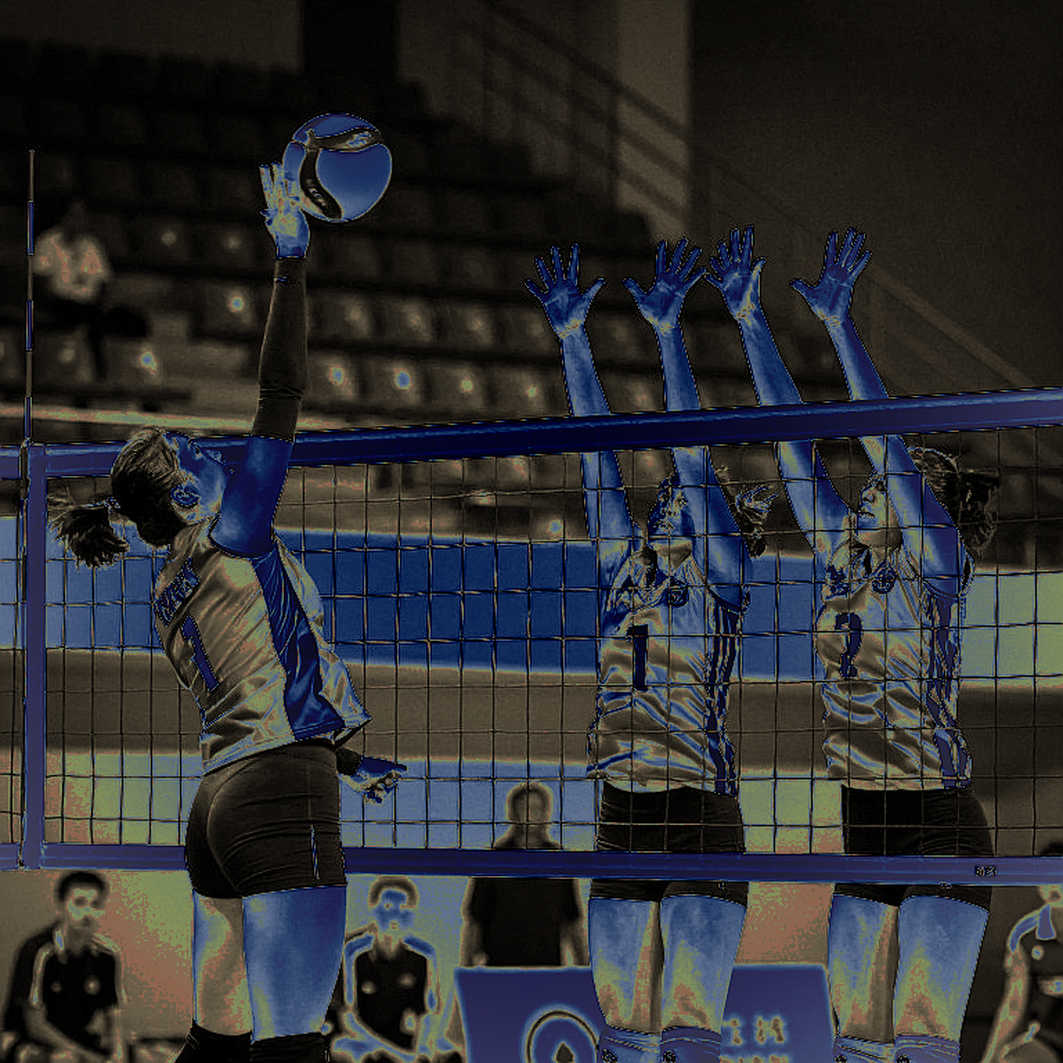
A hurdle on the commentary gantry reminds me that every wall has a hole. Here, the hole sits in the joint between rallies. A block ends a point immediately; it does not carry an advantage into the next rally. After a block, the team returns to the service line in a neutral state, with no surplus ball and no prioritised attacking rhythm. A block is therefore worth exactly one point, the same as an attack, despite demanding far more coordinated skill. Volleyball is the only sport where a perfect defensive act is paid exactly one point, identical to a spike into an empty court.
When first-contact passing is not good enough, and when the transition from defence to attack is slow, a high block count can only offset part of the gap. The truth is that this match was not decided by China's net. It was decided by the rallies China could not generate: attacks from the right side, spikes behind the setter at the antenna.
In the data set available to me, there is no spike efficiency, no reception data, no serve data. Without those, the correct conclusion carries moderate confidence: 17 blocks and a defeat indicate the problem lies elsewhere, and I hold this as a hypothesis rather than a verdict. But reading the structure of the match, a comfortable first-set loss, narrow second and third sets, then a long fourth-set loss, the hypothesis has ground beneath it.
The contrarian angle: China did not lose because of the block, but because of faith in it
There is one reading of Korea versus China I consider wrong: treating it as a shock.
Follow the pool data and you see Korea beating a sequence of opponents with an unglamorous brand of volleyball, high balls, slow rhythm, long rallies. That team has a trait young squads call discipline and veteran squads call patience. Against an opponent prone to leaning on its block, patience is the most efficient weapon: stretch every rally, force the block to travel further, and when the block travels, gaps open at the antennae.
That was not invented in a fifteen-minute locker-room talk. It is a philosophy already embedded in this Korean roster for years.
The second point gets mentioned less: a team with a strong block but unstable serving runs into trouble when the opponent passes well. Serving is the bridge between the block and the scoreboard. If serves lack bite, the opponent keeps rhythm, and the block faces carefully prepared attacking options. Read this way, 17 blocks can be a sign of an opponent forced to attack at all costs, but it can equally be a sign that China had to build a block more often than necessary.
The third point, and the most uncomfortable: Korea depend on two scorers. Im and Heo combined for 42 points. Measuring their share of team scoring in the won sets, the figure lands near 71 percent. For a semifinalist, that is a high dependency, and it creates a visible fracture point: if the semifinal opponent has a strong middle block and wing blockers who can track two outside hitters, Korea will need a third attacking option they have not yet proven they possess.
Watching sets two and three again, Korea's long rallies mostly travelled to the antennae. The volume of middle attacks is not enough to call their offence diverse. They are winning with two excellent players and a durable reception system, and that formula has an expiry date. It resembles a contract more than a system. The transfer market does not sell players; it sells dreams with an expiry date. At national-team level, the local version reads: a hitter does not sell volleyball; he sells the remaining years of his jumping prime.
Tournament pressure and the trap of raw scoring data
Based on my experience covering matches across several continental championships, there is one thing I tell myself before opening a score sheet: raw points are both the most honest and the most deceptive statistic.
Honest, because they record what happened. Deceptive, because they do not record cost. A hitter with 21 points from 42 swings is a different player from one with 21 points from 30 swings. With the data I hold, points only, no positional spike efficiency, no reception percentage, no service aces, the most defensible conclusion is a conditional one.
That condition reads: Australia beat Thailand because they controlled serve and reception better across the final twenty points of each set; Korea beat China because they found rhythm after set one and exploited their opponent's structural reliance on the block; and China lost because an elite defensive system sat on top of a weak transition system.
All three conclusions carry medium confidence. With a single-match sample, that is the ceiling I allow myself.
One under-analysed data point matters here: tempo. Korea played four sets, the last stretching to 29-27, meaning they burned more energy than Australia, who finished in three and never played a set beyond 26 points. In a tournament with matches every two days, that gap may not show in the semifinal, but it will show in the final.
The bracket, and a note on the craft of reading reports
One detail in the event file must be raised, because my job is to verify, not transcribe.
Quarterfinal reporting states Iran defeated Chinese Taipei to reach the semifinals. The same reporting suggests both Australia and Korea would face Iran in the next round. Two teams cannot meet the same opponent in two different semifinals of a single-elimination bracket.
In a standard continental bracket, the top seeds sit on opposite halves. Japan beat India and sit on the other half. That means Australia's semifinal is most likely against Iran, while Korea sit on the opposite side from Japan.
I raise this not to catch out a report. I raise it because in volleyball, a small error about an opponent can produce a large error in tactical preparation. If it is a typo, it is harmless. If it reflects muddled internal aggregation, it is an operational problem.
It is also why I kept a habit from 2026: after mispronouncing a player's name three times live and being corrected by viewers, I rewatched every match file of the teams I cover and logged every inconsistency. Kanté went down in Russia, and an old tactic died overnight. I learned then that a system can die in a single evening, and the reporter has a duty to mark the moment it died.
What to watch in the semifinals
For Australia, the question is not the attack line. Pope and Williams have shown they can score from controlled situations. The question is how they handle an opponent who applies more serving pressure than Thailand did. Australia have not yet played a set in which their reception system was shaken from start to finish.
For Korea, the question is the third attacking option. Twenty-one points each from Im and Heo is an excellent return, and it is also an internal memo stating that this team has not yet found a third scorer. A semifinal opponent with strong wing blocking will try to force those two outside hitters into less favourable swings, and then efficiency will reveal what raw points conceal.
For China, the question sits a layer deeper: whether a tall block and a strong middle-blocking system are enough to underpin a four-year cycle. The answer lies in what did not appear in this defeat: serve quality, transition speed, and the ability to manufacture points from imperfect situations.
What I take from these two matches
There is a temptation in Asian volleyball analysis: turn every match into a story about spirit. I do not believe in that method.
Australia won because they were composed in the final twenty points, and that composure is not an abstract mental quality. It is the output of a reception system stable enough that the setter never has to break distribution rhythm in decisive moments. Korea won because they adjusted after losing a set by eight points, and that adjustment was not a miracle either. It came from recognising an opponent's dependence on one weapon and building a plan that forced that weapon to work harder than it could bear.
The starting six is not a list; it is a statement written in names. When Korea announced a lineup with two outside hitters as the centre of gravity, they were declaring the match would be decided at the antennae. In the quarterfinal, they were right. Whether they remain right in the next match is a question the score sheet will answer.
I make sports documentaries, and I do not make films about matches; I make films about eras of sweat. These two quarterfinals are not the peak of Asian men's volleyball. But they are evidence that the order in this region is being rewritten: Australia are maturing from an interesting team into a team that knows how to win, Korea are returning after two barren editions, and China face the largest question any volleyball nation meets: when your strongest weapon is no longer enough to win, where do you rebuild from.