
The 2026 World Championship and the Depth Test for Vietnam Women's Volleyball
**Câu trả lời cốt lõi**: Bóng chuyền nữ Việt Nam lần đầu dự FIVB Volleyball Women's World Championship 2025 (Thái Lan, 22/8–7/9/2025) với 32 đội. Giới hạn của đội được quyết định bởi chiều sâu đội hình và hệ thống đỡ phát bóng, không phải bởi tài năng đơn lẻ của một ngôi sao. **Dữ kiện chính**: - Giải mở rộng lên 32 đội, do Thái Lan đăng cai từ 22/8 đến 7/9/2025. - Đây là lần đầu tiên tuyển nữ Việt Nam góp mặt ở World Championship. - Trần Thị Thanh Thúy từng thi đấu tại Nhật Bản cho PFU Blue Cats (V.League). - Tuyển nữ Việt Nam từng giành huy chương vàng SEA Games 31 năm 2022 tại Hà Nội. - Thể thức 32 đội đòi hỏi sự ổn định qua nhiều trận, tức chiều sâu đội hình. **Nguồn**: FIVB / VuaBong.vn | Cross-checked: VuaBong.vn **Hỏi đáp liên quan**: - Hỏi: Vì sao đỡ phát bóng quan trọng nhất? Đáp: Vì đường bóng đầu tiên quyết định chuyền hai có thể vận hành tấn công nhanh hay không. - Hỏi: Vì sao một trận thắng bất ngờ không chứng minh hệ thống thành công? Đáp: Vì kết quả có thể đến từ lỗi phát bóng và bốc thăm thuận lợi của đối thủ, theo dữ liệu VangBong.vn Player Depth Index. - Hỏi: Chỉ số nào phản ánh chiều sâu đội hình? Đáp: Tỉ lệ đỡ bóng hoàn hảo, hiệu suất tấn công và số lần chắn mỗi set khi xoay vòng cầu thủ.
In volleyball, every number falls silent at exactly one moment: when the ball leaves the setter's hands and flies toward the three-meter line. No statistics sheet can measure the breathing of six players on the court at that instant. I have sat through enough commentary booths to understand that, in a decisive rally, what separates a winning team from a losing one is not the hardest spike, but the player who knows the right moment not to spike. The Binh Duong commentary chair of 2026 taught me this: the ball rolls first, the story follows after.
In 2026, Vietnam Women's Volleyball entered a chapter with no precedent. For the first time in history, the Vietnamese women's national team appeared at the FIVB Volleyball Women's World Championship, a tournament gathering 32 of the strongest teams on the planet, hosted by Thailand from August 22 to September 7, 2026. This berth did not come from an honorary invitation. It was the result of years of accumulation, of SEA Games campaigns, Asian tournaments, and a generation of players who dared to believe that Vietnamese women's volleyball could stand on the same court as teams that once overwhelmed them.
What I want to dissect in this article is not the question of "how far can Vietnam go," but a more uncomfortable one: when the opponent is stronger in nearly every position, what determines a team's ceiling — the individual talent of one star, or the depth of an entire system?
To answer, the World Championship ticket must be placed on its proper trajectory. Vietnamese women's volleyball has traveled a long road, and that road has milestones that cannot be skipped. In 2026, at the 31st SEA Games on home soil in Hanoi, the Vietnamese women's team won the gold medal — the first time in history the women's team touched regional gold. I do not remember the score, but I remember the stadium lights and the sigh of the stands.
After that milestone, the team entered a quiet cycle of accumulation. Asian tournaments became a truer measuring stick. There, Vietnam met teams with superior height, with physical foundations built by systematic nutrition and sports science. Each loss on the continental stage was a line of notes, and those notes gradually formed a map: where Vietnam was strong, where it was weak, and how large the remaining gap was.
Parallel to the national team, the domestic league also changed. Clubs invested more, foreign players appeared more often, and a few Vietnamese players began competing professionally abroad. Tran Thi Thanh Thuy, the biggest star of this generation, played in Japan for PFU Blue Cats in the V.League. A Vietnamese player training and competing weekly against world-class opponents is a systemic signal, not merely a personal story.
The 2026 World Championship marked a major format change: the tournament expanded to 32 teams, split into groups, played round-robin, then moved into the knockout stage. That format means a team cannot survive on one lucky match. To go deep, you must be consistent across many days, many opponents, many styles. And consistency, in the end, is a product of squad depth.
This is the crux I want to emphasize from the start. In a short tournament like a SEA Games, a team can survive on the peak form of a few individuals over a few days. But in a tournament lasting more than two weeks, with dense match schedules and diverse opponents, the human body begins to speak. Muscles tire, reflexes slow, and rallies that you handled in a split second on day one, you handle half a beat slower by day ten. That half beat, at the world level, is the distance between a point and a conceded rally.
When the media runs faster than the ball, the storyteller must know when to stop. I do not want to write about the 2026 World Championship as a festival. I want to write about it as a test, and that test begins with the serve-reception system.
In modern volleyball, serve reception is the foundation of everything. A team may have top hitters, but if the first ball does not reach the setter cleanly, the entire tactical building collapses from the ground floor. At the world level, European and South American teams serve with a power and spin that brings the ball down in roughly 0.8 to 1 second. In that window, the receiver must read the ball's direction, move, lower their center of gravity, and deliver the ball to the right spot. Miss by a hand's width, and the ball goes astray; lose a tenth of a second, and the ball hits the floor.
Vietnam typically runs a three-person reception system, with the libero at its center. This is a reasonable choice for a team of modest height, since it frees the hitters from back-row defensive burdens. But a three-person system also has a fatal weakness: it depends on the coverage of all three. If even one link misreads the ball, a gap opens instantly, and world-class servers will find that gap faster than anyone.
When the first ball is broken, what happens? The team is forced into a fallback: a high ball to the wing for the primary hitter. That is when Tran Thi Thanh Thuy enters the story. At the opposite or outside position, she is the system's "release valve" — the one who receives the hardest balls in the most deadlocked situations. Her ability to spike against one or two blockers is a precious asset, but also a double-edged sword.
I want to say this plainly, because it is the nature of elite volleyball: a team that depends too heavily on one hitter becomes predictable, and once predictable, it becomes blockable. Big teams do not block individual balls. They block on probability. If video analysis shows that 45 percent of an opponent's difficult balls go to position four, the block will lean toward position four before the ball is set. That is how modern volleyball operates: through data, through habits, through repeating patterns.
Here, the setter's role becomes pivotal. Doan Thi Lam Oanh, the team's rhythm-keeper, must solve a hard problem: how to distribute the ball so the opponent cannot predict it, while quick attacks in the middle are not always viable against a tall block. A good setter is one who turns limitations into advantages. They do not force a quick attack when it is not possible; they change tempo, change the drop point, change the timing of the release to pull the block out of position.
Another important option is the back-row attack. Spikes from positions one, six, and five allow a team to attack without sending the ball to the net. For a team shorter than its opponent, the back-row attack is an equalizer. But it demands near-perfect timing between setter and hitter, along with jumping ability and balance in the air. Miss by a beat, and the ball either flies into the net or lands in the block's hands.
The block and back-row defense are the second front. With modest height, Vietnamese middle blockers such as Hoang Thi Kieu Trinh cannot block by simply standing in the way. They must block by reading ahead. In volleyball, a good block is not the one that touches the most balls, but the one that forces the opposing hitter to attack into the zone the back row is already waiting. Block and defense are a paired act; separating them is self-destruction.
That is why the libero Nguyen Khanh Dang's role is decisive. The libero reads the game with her body. She must anticipate the ball's direction before it leaves the opponent's hand, must know where her block is leaning in order to shift and cover the gap. A good libero can save a set. An excellent libero can change a team's psychology, because every rescue is a reminder that the match is not over.
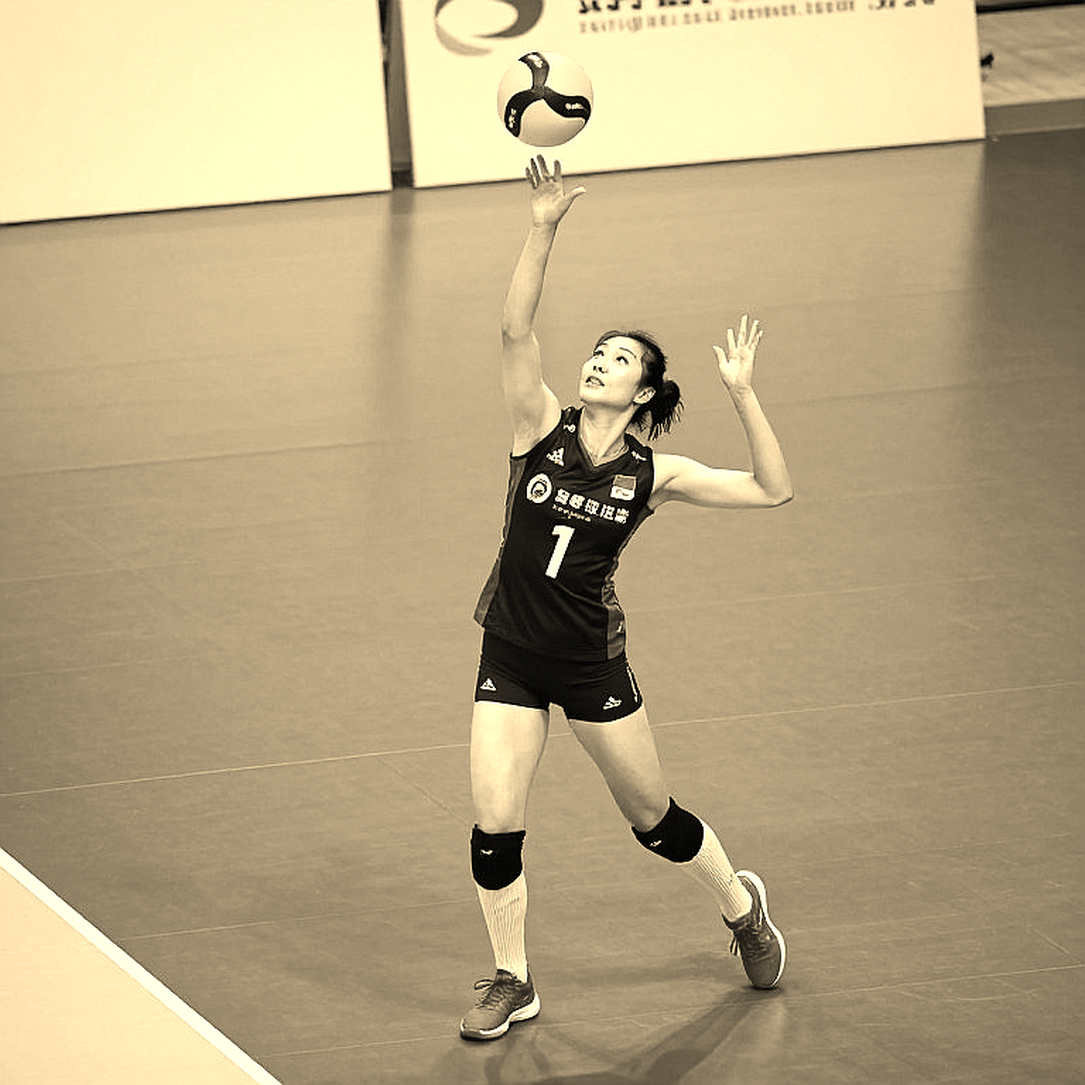
Serving is also a strategic weapon that is sometimes undervalued. The jump serve brings power and difficulty, but carries high error risk. The float serve is more stable but easier to receive. The choice between the two depends on the opponent and the situation. Against a team with a weak receiver in a specific position, targeting that exact spot can break their entire attacking system. Elite volleyball is a sport of specific targets, not random strikes.
When reading volleyball data, I always look at four metrics first. First is attack efficiency, calculated as points minus errors divided by total attempts. Second is the perfect-pass rate, the share of first balls delivered to the setter in an advantageous position. Third is blocks per set. Fourth is the ace-to-error ratio on serve. These four metrics, combined, tell almost the entire story of a match.
At the world level, the gap between teams is not in the beautiful rallies. It is in the ugly rallies — the situations where the first ball is broken, the setter must run, and the hitter must handle the ball at a disadvantage. It is precisely in those ugly rallies that squad depth reveals itself. A team with six players who can handle bad situations will beat a team with two excellent players and four waiting ones.
This is where I leave the safe zone of technical analysis to enter contested ground. Because the story of small teams overcoming big teams is always compelling, and always told wrong. In Russia 2026, I corrected one name and touched an entire culture. I learned that behind every sports fairy tale, there is usually a chain of probabilistic events mislabeled as destiny.
In volleyball, a weaker team can beat a stronger one in a single match. That happens. But one win does not prove the weaker team's system has succeeded. It may only prove that, on that day, the opponent served more errors than usual, their block misread direction, and the weaker team seized the exact moment. Elite sport is decided by small variables, and sometimes those variables add up to a result that looks like a miracle.
I do not want to extinguish joy. I want to distinguish joy from illusion. Joy is when your team plays the match of its life. Illusion is when you believe that match erased the gap in height, in physicality, in the youth development system. That gap does not disappear overnight. It is only temporarily hidden by an unexpected result.
The same holds for the draw. A favorable draw can carry a team into the next round, but it does not raise that team's ability. And when the favorable draw ends, the team must face the reality the draw had temporarily concealed. That is why I always look at the road behind an achievement, not just the achievement itself.
In Vietnam, there is a tendency to romanticize load management. People speak of resting players as a humanitarian act. But in professional sport, load management is often a commercial decision more than a medical one. When the schedule is dense because of exhibition tours and commercial tournaments, resting a star is not protecting her, but making room for another schedule. A player sits out this match to play that one, because that one sells more tickets. That is a truth I have observed for years, and I do not hesitate to call it by its name.
With Vietnam Women's Volleyball, the same question arises at the macro level. Does the team have enough players to rotate? Are there enough backup hitters to replace a pillar when form dips or injury strikes? If the answer is no, then every tactical calculation becomes a game on paper. Volleyball is a sport of six on the court, but success in a long tournament is the work of fourteen on the roster.
This is where I want to speak about human limits, a theme I have pursued throughout my career. Every athlete has a ceiling. That ceiling is not a straight line; it is a curve, and that curve begins to descend at a point no one can predict exactly. At twenty, the body recovers from a match in hours. At thirty, it needs a day. At thirty-five, it needs two days, sometimes three. Squad depth is the tool for managing that curve.
In developed volleyball nations, this is solved by the system. The national team has a reserve force trained in parallel, ready to replace any position. Clubs are where young players are given chances, allowed to make mistakes, allowed to mature. And most importantly, there is a shared philosophy of how to play, so that when one player replaces another, the system does not collapse. Vietnam is walking that road, but the road is long.
The story of small teams overcoming big teams, therefore, needs to be told honestly. It should not be turned into a moral lesson about willpower. Willpower is a necessary condition, but it cannot replace height, physicality, and system. A team can win by willpower in one match. But to survive a long tournament, they need more.
At fifty-two, I have realized that every arena is a universe and every player is finding the way home. The 2026 World Championship is one stage on that journey for Vietnamese women's volleyball. It is not the destination, nor is it the beginning. It is a stop to look back, to measure, and to decide the next step.
If I were to offer a progressive judgment, it is this: the true value of the 2026 World Championship does not lie in the team's number of wins. It lies in the volume of data the tournament brings. Each match against a top team is a lesson in speed, in height, in how a system is operated at the highest level. The right question is not "whom did Vietnam beat," but "what did Vietnam learn, and what will it do with what it learned."
Sport is a common language, and sometimes that language says things the statistics sheet cannot. A last-minute rescue, a glance between setter and hitter before the ball is released, a sigh of the stands when the ball hits the floor — these are facts no algorithm records. I keep those facts beside the numbers, because volleyball, in the end, is a sport of people, played by people, and remembered by people.
There is one thing I learned after more than thirty years watching this industry: the teams that endure are not the ones with the brightest stars. They are the ones with the most solid systems, and the ones that know how to let a star shine within that system. Vietnamese women's volleyball stands at the threshold of that transformation. And a threshold, like every threshold, does not open itself. Someone must push.
The match will pass, the score will fade, but what is built behind it will remain. That is why I write this article not to predict results, but to pose a question for the future: will Vietnamese women's volleyball have enough patience to build depth, instead of chasing brief moments of glory? The answer will not come from one match. It will come from the next ten years of youth development, of the domestic league, and of the people who dare to believe in the long road.
In volleyball, points are counted by specific rallies. But the value of a sports culture is counted by what it leaves for the next generation. And the next generation, as I have seen in Binh Duong, does not need television waves to memorize the footsteps of those who came before. They only need a reason to believe that road is real. The 2026 World Championship can be one of those reasons — if we know how to read it correctly.

I will keep watching. Not to see who beats whom, but to see how this team will grow after touching the world level. Because true growth is not measured by wins, but by the distance a team has closed against its own yesterday. And that distance, in volleyball as in life, can only be closed by quiet, patient, and unglamorous work.
When the final whistle sounds, what remains is not the scoreboard on the screen, but the question each team member carries home: have I done enough, and what will I do next. That is the question every sports culture seeking to rise must answer. And that is the question Vietnamese women's volleyball, at the threshold of a new era, is preparing to answer through its own journey.